
Guides · Owning a generator
Should You Repair Your Generator or Replace It?
Repair a generator when the fault is in a replaceable part, such as the battery, charger, controller, AVR, starter or fuel system, and the engine and alternator are sound; that covers most breakdowns. Consider replacing it when the engine is worn out, parts can no longer be found, the repair would cost a large share of a suitable new set, or the generator no longer suits your load, fuel or noise needs. A proper diagnosis comes first, because it turns a guess into a comparison.
Technical guide · Last reviewed 16 October 2026
Faults that are usually worth repairing
| Fault | Typical repair |
|---|---|
| Flat battery or failed charger | Typical repairReplace the battery or the charger |
| Controller fault or an obsolete panel | Typical repairRepair it, or fit a current controller in its place |
| AVR or rotating diode failure | Typical repairReplace the failed part, after finding what caused it |
| Fuel system faults | Typical repairFilters, lift pump, injectors, or cleaning out contaminated fuel |
| Starter motor or charge alternator | Typical repairRepair or replace the unit |
| Overheating from the cooling system | Typical repairRadiator cleaning, thermostat, water pump, hoses or belts |
| Changeover or ATS faults | Typical repairContactors, timers or the mains-sensing relay |
| Carburettor faults on petrol units | Typical repairClean or replace the carburettor |
If your generator has one of these faults, generator repairs explains how a repair visit works.
The decision in one flowchart

The machine itself
Four checks on the generator’s condition
Running hours, more than age
Engine wear follows running hours more than years, although hoses, seals, wiring and batteries still age with time. A ten-year-old standby set that seldom ran can be in better shape than a three-year-old one that carried a business through months of load shedding. The hour meter, and the service record behind it, tell you more than the date on the nameplate.
Engine wear
Heavy oil use, blue smoke, heavy fumes from the crankcase breather (blow-by), low compression readings, a knock, or hard starting that a good battery and clean fuel do not cure all point to internal wear. A rebuild is a major job; compare it with a replacement engine or a complete set. See generator smoke for what the colour says.
The alternator: Generator rewinding
Burnt or shorted windings can be rewound, which is often worthwhile on larger machines. On small portable units a replacement alternator, or a new generator, may cost about the same.
Parts availability
Engines and alternators from established makers usually have parts for many years, found from their data plates. Some older or less common sets, including some low-cost imports, take longer, and an obsolete controller is normally replaced with a current one rather than repaired.
When the generator no longer suits the job
| What changed | What it means for the decision |
|---|---|
| Your load has grown | What it means for the decisionA borehole pump, air conditioning or more office equipment can push a set into overload. A repair fixes the fault, but the set keeps tripping. Re-size with the kVA sizing guide. |
| Your load has shrunk | What it means for the decisionWhere solar panels and a battery inverter have taken over the essential circuits, a large diesel set may run for hours lightly loaded and suffer wet stacking. Planned load bank testing, or a smaller set, may suit you better. |
| You need it to start by itself | What it means for the decisionA manual set with an electric starter can usually be given an auto-start controller and an automatic changeover, which is an upgrade to the existing generator, not a reason to replace it. A recoil-start unit cannot start itself, so automatic starting means a different set. |
| The fuel no longer suits you | What it means for the decisionA petrol unit refuelled from containers suits short outages, not long ones. For frequent, long outages a diesel generator uses less fuel for the power it makes; a gas generator suits sites with a reliable gas supply. |
| Noise rules or neighbours | What it means for the decisionEstates and municipal by-laws limit noise, especially at night. An open-frame unit may need replacing with a set in an acoustic canopy; sometimes a better silencer or enclosure is enough. |
| Reliability now matters more | What it means for the decisionIf the generator now protects stock, medical equipment or a business’s trading hours, a long record of breakdowns counts for more than the cost of the next repair. |
Look at the whole set, not just the fault
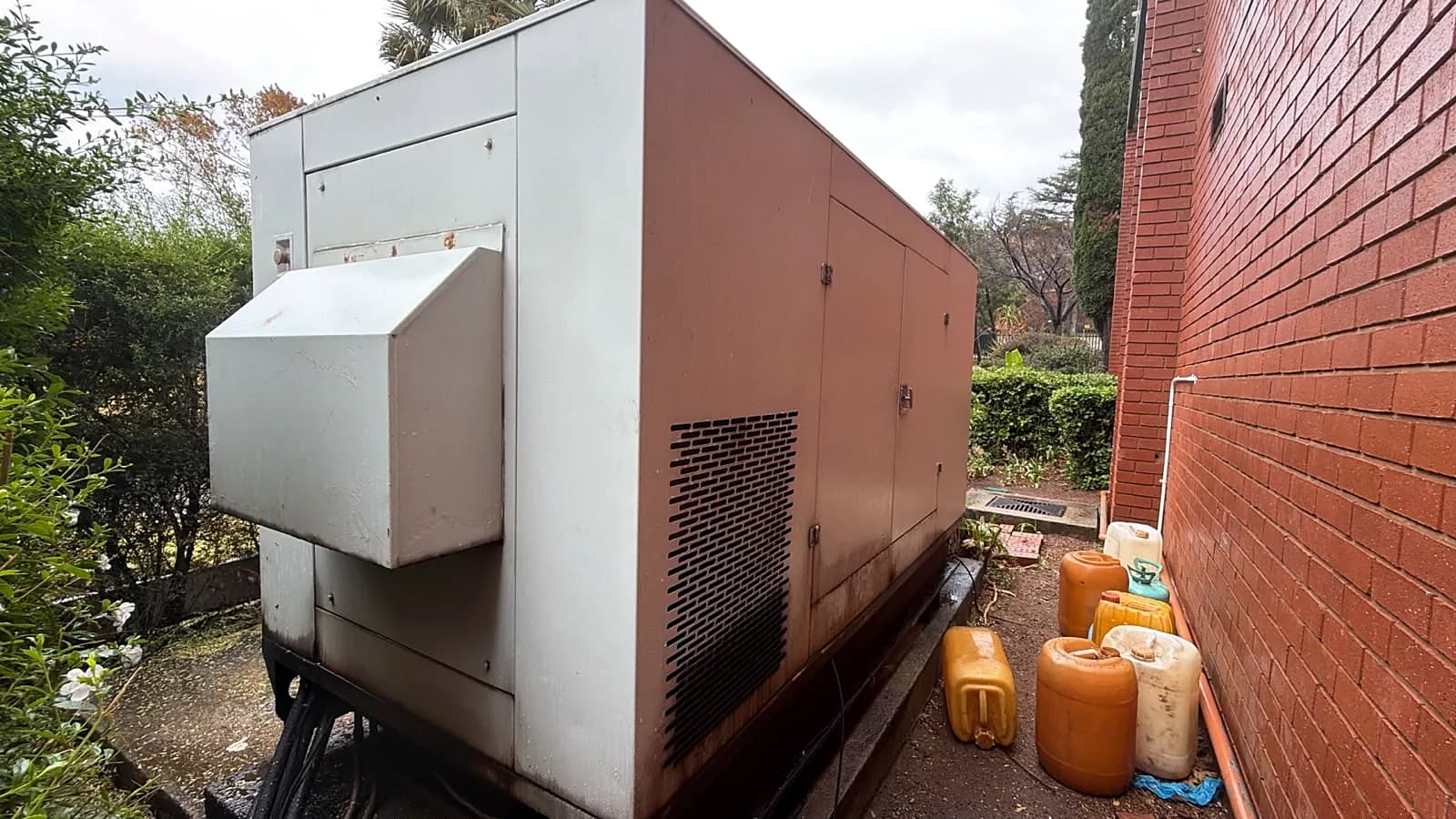
The fault that stopped the generator is rarely the only thing to weigh. Rust along the base frame can point to a corroding base fuel tank, which sheds rust and lets water into the diesel and is costly to put right. Brittle wiring, perished anti-vibration mounts, a radiator core eaten by corrosion or a canopy that no longer keeps out rain all add to what the next few years will cost.
A diagnosis should note these as well as the fault, so the quotation shows the real state of the machine.
- Base tank and frame corrosion
- Wiring, mounts and radiator core
- Canopy seals and doors
- The service and repair record
Comparing like with like
How to weigh the cost of each option
Compare the repair quotation with the full cost of replacement, not just the price of a new set. Replacement usually also means delivery, a plinth or base, connection, possibly a new or larger changeover panel, removal of the old set, and commissioning. Connection to the building’s wiring must be done by a registered electrical contractor, who issues a Certificate of Compliance. Our generator installation page explains what an installation involves.
Then compare what each option buys. A repair on a sound, low-hour engine can give many more years of service. A major repair on a high-hour engine with other wear may only buy time. There is also a middle path: repair now to get through the season, and plan a replacement with the next budget.
The generator repair cost page explains what drives the price of a repair, and why an accurate quotation starts with finding the fault.
Ask for these before you decide
- The diagnosis in writing: what failed, and why
- The engine hours, and notes on the engine and alternator condition
- Whether the parts are available, and how long they take
- Any other wear found, so you see the whole picture
- If replacing, whether the existing changeover, cabling and base can be reused
- If replacing, a size based on your loads today, not the old nameplate
FAQ
Frequently asked questions
Is an old generator worth repairing?
Often, yes. Age alone matters less than running hours, condition and the service record. A well-maintained older set with a sound engine is usually worth repairing.
Is a cheap petrol generator worth repairing?
Usually for carburettor, starter, AVR and recoil faults. If the engine has seized or the alternator windings have burnt, a new unit may cost about the same as the repair.
How many hours does a generator engine last?
It depends on the engine type, how it is loaded and how well it is serviced, so there is no single figure. A water-cooled diesel built for standby or prime power is designed for far more running hours than a small air-cooled petrol engine. The engine manufacturer’s documentation gives the expected interval to a major overhaul.
Can my changeover panel be reused with a new generator?
Often, if it is rated for the new set’s current and phase and is in good condition. It has to be checked before you rely on it; see single-phase vs three-phase if the new set will differ.
Can you quote for both repair and replacement?
We diagnose the fault and quote for the repair, and advise on replacement where repair does not make sense. Free callouts and quotations.
Related pages
Related services
Related generator problems
Need a generator technician?
- 24/7 operations
- We Arrive Within 1–2 Hours (usually within 1 hour)
- Free callouts and quotations