
Alternator windings
Rewinding Burnt or Failed Generator Alternators
Rewinding replaces the burnt or broken-down copper windings and insulation in a generator’s alternator, so it produces its rated output again. We test the stator, rotor and exciter windings on site first, explain whether drying out, rewinding or a replacement alternator makes most sense, and arrange and quote the rewind if one is needed.
- Stator, rotor and exciter windings tested on site
- Damp windings dried out where the tests allow
- Rewind or replace explained before you decide
- Removal and refitting on site, then a run under load

Established 2006
20 years of experience
24/7 operations
We Arrive Within 1–2 Hours
(usually within 1 hour)
Free callouts and quotations
One-year warranty
Qualified and certified technicians
We Service & Repair All Generator Brands
All generator makes and models
1 kVA–20,000 kVA capability
Signs the windings may have failed
| Symptom | Likely causes | Repair route |
|---|---|---|
| Burning smell, smoke or scorching at the alternator | Likely causesOverload, overheating or insulation breaking down | Repair routeShut down and call |
| No output after an overload, short circuit or lightning strike | Likely causesDamaged windings, failed rotating diodes or a failed AVR | Repair routeRunning but no power |
| Low or unbalanced voltage on one phase | Likely causesA shorted or open section of the stator winding, or badly unbalanced loading | Repair routeVoltage problems |
| Voltage will not build, even with a new AVR | Likely causesLost residual magnetism on a self-excited alternator, failed rotating diodes, an open or shorted exciter winding, or a main rotor fault | Repair routeAVR repairs |
| Earth fault trips that persist with the load disconnected | Likely causesInsulation broken down to the frame, often after moisture got in | Repair routeInsulation testing |
| The set stood in a flooded or very damp plant room | Likely causesWater in the windings and the terminal box | Repair routeTest and dry out before running |
Why alternator windings fail
Overload and overheating
Running above the rating, or with badly unbalanced phases, heats the copper beyond what the insulation is designed for. Each episode shortens its life.
Blocked cooling air
The alternator’s fan draws air through the windings. Dust, leaves, nests or a cluttered canopy cut the airflow, and the windings run hot even at normal load.
Moisture
Standby sets stand idle for weeks. Condensation, driving rain in Highveld summer storms and damp plant rooms lower the insulation resistance until it breaks down.
Age
Varnish and insulation turn brittle after years of heating and cooling, crack under vibration, and eventually let windings short to each other or to earth.
Lightning and surges
A nearby strike or a surge on the network can puncture insulation. A faulty changeover that lets the mains and the generator connect together can do serious damage.
Short circuits
A fault on the cabling or switchboard close to the generator draws a very high current until the protection trips, and the stress can distort and burn windings.
Stator, rotor or exciter: which winding has failed?
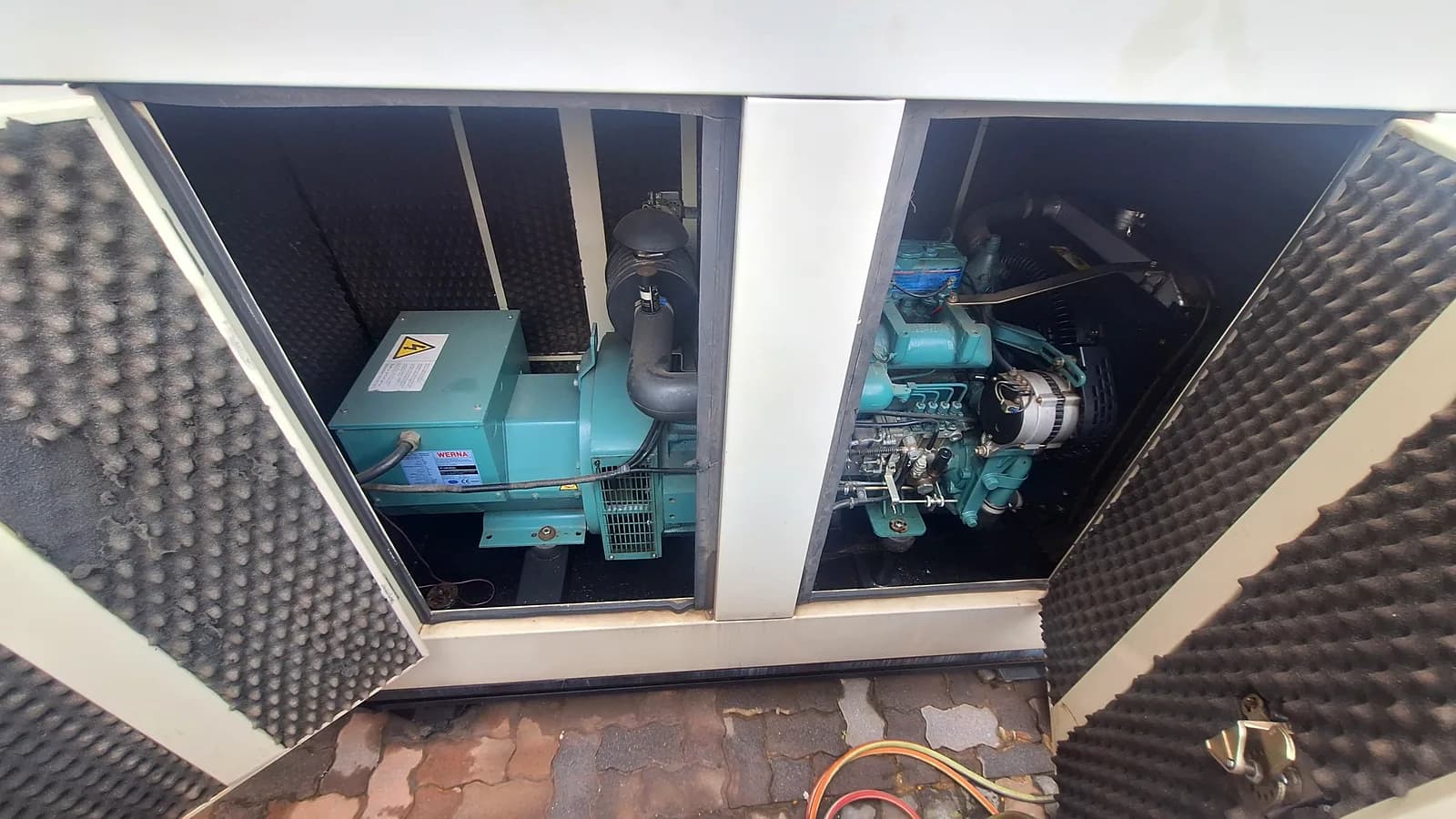
A brushless alternator has more than one set of windings, and the repair depends on which has failed. The main stator is the stationary outer winding that produces the output power; it is the largest winding and usually the costliest to rewind. The main rotor carries the magnetic field and spins inside it.
The exciter is a small generator on the same shaft. Its stator winding is fed by the AVR, and its rotor output passes through the rotating diodes to energise the main rotor. Some alternators also carry a permanent magnet generator (PMG) that powers the AVR. Rewinding an exciter is a much smaller job than rewinding a main stator.
- Main stator: the output winding
- Main rotor: the rotating field
- Exciter stator and rotor: the small windings that feed the field
- Rotating diodes: often the cheaper fault behind apparently failed windings
Tests that decide the repair
| Test | What it shows | What it can lead to |
|---|---|---|
| Insulation resistance | What it showsWhether each winding is insulated from the frame and from the others, or is damp or broken down | What it can lead toReturn to service, drying out, or a rewind |
| Insulation resistance over time (polarisation index) | What it showsWhether the insulation is clean and dry, or damp and contaminated, which a single reading cannot show reliably | What it can lead toDry out and retest, or plan a rewind |
| Winding resistance | What it showsOpen circuits, poor joints and shorted turns, found by comparing the phases with each other and with expected values | What it can lead toA rewind of the affected winding |
| Rotating diodes and surge suppressor | What it showsFailed diodes that stop the main rotor being energised | What it can lead toDiode replacement, not a rewind |
| Exciter field and AVR output | What it showsWhether the fault is in the exciter winding or in the regulator feeding it | What it can lead toAn AVR replacement or an exciter rewind |
| Visual inspection | What it showsDiscoloured, cracked or burnt insulation, rubbing, oil or dust contamination | What it can lead toSupports or questions the test results |
Dry out, rewind or replace?
Windings that test low because they are damp, but show no burning or breakdown, can often be dried out instead of rewound. Heat is applied with space heaters, warm air or a controlled current through the windings, and the insulation is retested until the readings recover. It takes time, but it costs far less than a rewind.
Where the copper or insulation is damaged, the choice is between rewinding and a replacement alternator. Rewinding usually makes sense on larger alternators, especially where a matching replacement would have to be imported or the alternator is built into the set in a way that makes a swap awkward. A replacement can make more sense on small sets, where a new alternator costs little more than a rewind, or where a severe fault has damaged the core laminations.
We set out the cost and lead time of each option before anything is removed. The same thinking applies to the generator as a whole, and our guide on whether to repair or replace a generator covers it.
Process
How an alternator is rewound
- 01
Test on site
Insulation, winding and diode tests locate the fault and confirm that a rewind is needed.
- 02
Remove the alternator
The alternator, or the affected part, is uncoupled from the engine and removed on site, with the terminal connections and coupling recorded.
- 03
Strip and record
The old windings are cut out, and the wire size, number of turns, coil pitch and connections are recorded so the new winding matches the original.
- 04
Rewind and varnish
New insulation and copper are fitted, then the winding is impregnated with varnish and baked to cure it.
- 05
Test before it returns
Insulation and winding resistance are tested again, and a rewound rotor is balanced, before the alternator comes back to site.
- 06
Refit and prove
The alternator is refitted, aligned to the engine and reconnected, then run under load to confirm voltage and phase balance. A load bank test proves it at full output.
Keeping new windings healthy
A rewind restores the alternator, but whatever caused the failure is still there until it is dealt with.
- Find and fix the cause: overload, unbalanced phases, a faulty changeover or blocked cooling air
- Run the set under load regularly, so the windings warm up and drive off moisture
- Fit or repair anti-condensation heaters on standby sets in damp plant rooms
- Keep the alternator’s air inlet and outlet clear of dust, leaves and stored items
- Spread single-phase loads evenly across the three phases
- Include insulation testing in the maintenance plan
We work on alternators of every common make, including Stamford, Leroy-Somer and Mecc Alte. We Service & Repair All Generator Brands.
FAQ
Frequently asked questions
Is rewinding cheaper than a new alternator?
Often, especially on larger generators, but not always. It depends on the alternator’s size, any damage to the core, and whether a matching replacement is available. We quote both where it makes sense.
My generator has no output. Does it need a rewind?
Not necessarily. Most no-output faults turn out to be a failed AVR, failed rotating diodes, lost residual magnetism or a tripped breaker. See running but no power. The windings are tested before a rewind is ever suggested.
Can damp windings be saved?
Often. If tests show the insulation is damp rather than damaged, drying it out and retesting can restore it. Running a damp alternator before it is tested risks turning a drying-out job into a rewind.
How long does a rewind take?
It depends on the alternator’s size, which windings need work and the workshop’s lead time. A small exciter winding is quick; a large main stator takes longer. We give you the expected time with the quotation.
Is it worth rewinding a small portable generator?
Sometimes. On small portable sets a replacement alternator or stator is often quicker and costs about the same. We test first and tell you which makes sense.
Related pages
Related services
Related generator problems
Related brands
Who we work for
Need a generator technician?
- 24/7 operations
- We Arrive Within 1–2 Hours (usually within 1 hour)
- Free callouts and quotations