
Generator problems
Why Generators Overheat, and How the Cause Is Found and Fixed
The short answer
A generator overheats when its cooling system cannot carry heat away as fast as the engine makes it: the coolant is low or worn out, air cannot pass through the radiator, the fan, belt, thermostat or water pump has failed, or the engine is overloaded or breathing its own hot air. Switch off, let it cool completely, and never open a hot radiator cap: the coolant is under pressure and can scald.
- Switch off and let it cool completely
- Never open the radiator or expansion cap while it is hot
- Check the coolant level only when the engine is cold
- Do not keep resetting a high temperature shutdown
Need it fixed rather than diagnosed?
Free callouts and quotations. We arrive within 1–2 hours, usually within 1 hour.
When does it overheat?
| Symptom | Likely causes | Repair route |
|---|---|---|
| Climbs steadily after an hour or more under load | Likely causesRadiator fins packed with dust, grass or leaves; a slipping fan belt; coolant low or past its life | Repair routeRadiator clean, belt and coolant service |
| Overheats within minutes of a cold start | Likely causesThermostat stuck shut, water pump not circulating, coolant very low, or an airlock left after a coolant change | Repair routeCooling system repair |
| Only on hot afternoons or long load-shedding runs | Likely causesCooling capacity eroded by a partly blocked core or weak coolant mix, or hot air recirculating in the canopy or plant room | Repair routeRadiator care and ventilation |
| Started after more equipment was connected | Likely causesOverload: more kW means more fuel burnt and more heat for the radiator to shed | Repair routeLoad and sizing review |
| Coolant keeps going down, nothing on the ground | Likely causesCoolant pushed out of the overflow when hot, a weak radiator cap, or an internal leak such as a head gasket | Repair routeWhite smoke and head gasket checks |
| Coolant dripping under the set | Likely causesHoses or clamps, the radiator core, the water pump seal or the drain tap | Repair routeTrace and repair the leak |
| High temperature alarm, but the engine is not hot | Likely causesFaulty temperature sender or switch, damaged wiring, or a wrong set point in the controller | Repair routeSensor and controller check |
| Small air-cooled unit hot, smelly and losing power | Likely causesCooling fins and fan shroud clogged, run in a confined space, or overloaded | Repair routePortable and inverter generators |
How a generator gets rid of its heat
Only part of the energy in the diesel becomes electricity; a large share leaves as heat that the cooling system must remove. On a liquid-cooled set, the water pump pushes coolant through passages around the cylinders and head. The thermostat stays shut until the engine is warm, then opens to send coolant to the radiator, where a fan, usually belt-driven, forces air through the fins. The radiator cap holds the system under pressure, which raises the boiling point well above that of open water.
Small petrol generators, home standby units such as many Generac models and small single-cylinder diesels are air-cooled instead: a fan on the flywheel blows air through a shroud and over finned cylinders. There is no coolant to check, but blocked fins or a crowded space overheat them just as quickly, and many small units have no temperature shutdown at all, only a low-oil cut-out.

Causes explained
Where the heat stops getting out
Coolant: Coolant and radiator care
Low coolant leaves hot spots in the head. Too much plain water lowers the boiling point, and coolant with spent inhibitors lets scale and corrosion coat the passages and radiator tubes so they shed heat poorly. Different coolant types should not be mixed.
Radiator core
Dust, grass cuttings, leaves and insects pack between the fins, and oily residue makes them stick. The face can look clean while the middle of the core is blocked; scale can also block the tubes from inside.
Fan and belt
A worn, glazed or loose belt slips under load, slowing the fan and, on many engines, the water pump. A squeal at start-up is often the first warning.
Thermostat
Stuck shut, it keeps hot coolant in the engine and the temperature shoots up soon after starting. Stuck open, the engine runs cold instead, which on a diesel encourages wet stacking.
Water pump
A worn impeller circulates too little coolant. Coolant weeping from the small hole under the pump means its seal is failing and the bearing may follow.
Overload
An engine asked for more than its rating burns more fuel and makes more heat than the radiator was sized for, and often shows black smoke at the same time.

Canopies, plant rooms and Highveld summer afternoons
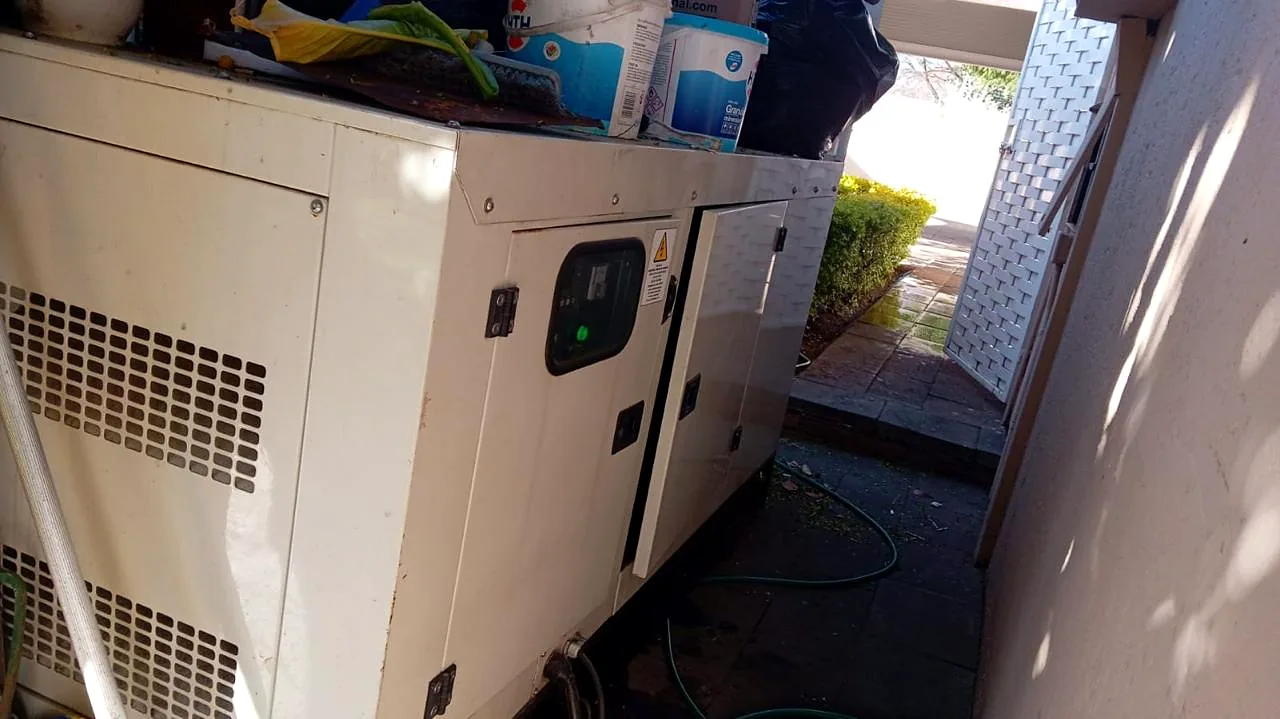
Most canopied sets draw cool air in at the alternator end, pass it over the engine and push it out through the radiator. If that hot air cannot get away, because the outlet faces a wall, the set sits in a narrow passage or boxes are stacked on the canopy, it is drawn back in and the engine breathes ever-hotter air. Plant rooms have the same problem when the louvres are blocked or the radiator is not ducted to the outside.
Gauteng conditions make it worse. Summer afternoons are hot, and at Highveld altitude the thinner air carries away less heat, so a cooling system with little margin left gets found out. Long load-shedding runs through the hottest part of the day, and leaves and grass blown into radiators by summer storms, eat into that margin further.
- Keep the clearances in the installation manual on every side
- Nothing stored on or against the canopy
- Plant room louvres open, clean and unobstructed
- Radiator air ducted outside, not into the room
What you can check once it is cold
Wait until the engine and radiator are cool to the touch, and switch the set off at the controller first.
- The coolant level in the expansion bottle, against its cold mark
- Wet hoses, coolant stains or crusty deposits around the radiator and pump
- Whether the radiator face is clogged with dust, grass or leaves
- That the fan belt is present and not frayed or cracked (look only; keep hands clear of the fan)
- That canopy louvres, doors and the air outlet are clear, with nothing stacked on top
- Whether the load was higher than usual, and what the controller showed when it stopped
Write down the alarm text and the temperature shown on the controller. It tells the technician whether it was a warning or a full shutdown.
Diagnosis
How the cause of overheating is traced
- 01
Verify the reading
The controller’s temperature is checked against an independent measurement, so a faulty sender is not mistaken for a hot engine.
- 02
Pressure-test the system
Finds leaks that only show under pressure, and checks that the radiator cap holds.
- 03
Map the radiator
Temperatures across the core show blocked sections; airflow through the canopy or room is checked for recirculation.
- 04
Test the circulation path
Thermostat, water pump, belt tension and fan drive, one at a time.
- 05
Check for combustion gas
A test of the coolant confirms or rules out a head gasket before any engine work is quoted.
Repairs for each cooling fault
| Cause found | What the repair usually involves |
|---|---|
| Low coolant from a leak | What the repair usually involvesRepair the hose, clamp, pump or radiator, then refill and bleed with the correct coolant mixture |
| Radiator blocked outside | What the repair usually involvesClean the core against the direction of airflow, without bending fins; fit a guard or move the set if debris keeps returning |
| Radiator scaled inside | What the repair usually involvesFlush the system; a badly scaled or corroded core is repaired, re-cored or replaced |
| Belt slipping or broken | What the repair usually involvesReplace the belt and set its tension; check the pulleys for wear |
| Thermostat or water pump | What the repair usually involvesReplace the failed part, then refill and bleed the air out |
| Hot air recirculating | What the repair usually involvesClear the space, improve louvres or ducting, or reposition the set |
| Overload | What the repair usually involvesRebalance or shed load, or resize the set using a load and kVA review |
| False alarm | What the repair usually involvesReplace the sender or repair its wiring, and confirm the controller set point |
| Head gasket | What the repair usually involvesEngine repair, after checking the head for warping or cracks |
Every repair ends with a test run, under load where the site allows, while the temperature is watched, so the fix is proved before the next outage.
Keeping it cool through the next outage
Most overheating starts as a slow loss of cooling margin that nobody notices until a long, hot run. A service that cleans the radiator, checks the coolant’s strength and condition and inspects the belt and hoses catches it early; on dusty sites or sets near trees, a maintenance plan with more frequent radiator checks is worth having.
If it has already shut down, send us the make, model and kVA, the hour-meter reading and a photo of the controller screen showing the alarm. Our generator repairs team can then come prepared for the likely cause.
FAQ
Frequently asked questions
Can I top up the radiator with plain water?
Top up only when the engine is cold, and with the coolant mixture the engine specifies. Plain water lowers the boiling point and corrosion protection; if you had to use it in an emergency, tell us so the mixture can be corrected.
Why does it only overheat during long outages or on hot days?
A cooling system that is partly blocked or low on coolant copes with short runs but not with hours at load on a hot afternoon. Back-to-back load-shedding slots expose it first. Treat it as an early warning and have it checked before it fails completely.
Is it safe to reset the alarm and restart?
Only once it has cooled fully and the coolant level is correct. If it trips again, stop and call us: repeated runs at high temperature can warp the cylinder head and damage the head gasket.
Could it be the temperature sensor rather than the engine?
Yes. If the alarm comes on but the engine and radiator are not hot, the sender or its wiring may be at fault. It needs testing before the engine is assumed to be fine.
How often should the radiator be cleaned?
It should be inspected at every service. Sets on dusty industrial sites, near trees or beside lawns that are mown often may need cleaning between services. See coolant and radiator care.
My portable petrol generator is very hot to touch. Is that normal?
Air-cooled engines do run hot, especially around the exhaust. Loss of power, a burning smell, oily smoke or the engine cutting out are not normal: let it cool, clear the fins and the space around it, and check the load.
Related pages
Related generator problems
Generator types
Related brands
Who we work for
Need a generator technician?
- 24/7 operations
- We Arrive Within 1–2 Hours (usually within 1 hour)
- Free callouts and quotations