
Guides · Owning a generator
What to Check Between Services, and What a Full Service Covers
A generator service checklist has two halves: quick, safe checks the owner makes every week or month, and the full service a technician carries out at the interval in the engine manufacturer’s schedule. Between them they cover fuel, oil, coolant, air, the battery, the alternator, the controller and the changeover, and they end with a test run that proves the set will take the load. Use the lists below to keep watch between visits and to judge whether a service was complete.
Technical guide · Last reviewed 16 October 2026
Weekly owner checks, from outside the generator
Five minutes a week, with the canopy closed, catches many of the problems that stop a standby set starting in an outage.
- The controller shows automatic mode and no warning or alarm. Photograph anything unusual before pressing a button
- Write down the hour-meter reading and the date
- Read the fuel gauge or sight glass and never let the tank run low: water and sludge settle at the bottom, and a diesel set that runs dry needs its fuel system bled. Top up with the engine stopped, from clean, sealed containers
- Look under and around the set for fresh oil, coolant or diesel, and notice any smell of fuel
- Check that the air vents, radiator grille and exhaust outlet are clear of leaves, nests, stored boxes and washing
- Where the battery charger has a light or display you can see without opening a panel, check that it shows charging
- Make sure the emergency stop is released and the canopy doors are locked
If the controller shows an alarm, the controller alarms guide explains what its category means before you reset anything.
Monthly checks, with the engine cold
Switch the controller off or press the emergency stop first, so the set cannot start while your hands are inside the canopy. Put it back in automatic when you finish.
- Oil level on the dipstick, between the marks. Note how much you add, and use only the grade given in the engine manual
- Coolant level in the expansion tank against its marks. Never open the radiator cap on a warm engine
- Battery terminals and clamps: look for white or green corrosion and loose cables, without touching them
- The clear bowl under the fuel filter, if there is one: water collects at the bottom. Report it rather than draining it yourself
- The air filter restriction indicator, if fitted: a coloured band in the window means the filter needs attention
- Fan belts and hoses: look for cracks, fraying, swelling or wet patches
- Last, with the doors closed and the controller back in automatic: if neither load shedding nor the controller’s exercise timer has run the set this month, start it from the controller as its manual describes and watch for alarms, smoke or new noises
What the oil tells you is covered in service intervals and oil care, and coolant in coolant and radiator care.
The technician’s checklist, system by system
| System | Checked, tested or replaced | What it guards against |
|---|---|---|
| Lubrication | Checked, tested or replacedOil and oil filter changed to the specified grade; the drained oil looked at for fuel, coolant or metal; breather and seals checked | What it guards againstBearing wear, sludge and a low oil pressure shutdown |
| Fuel | Checked, tested or replacedFuel filters renewed, water separator drained, lines and lift pump inspected, tank checked for water and sludge | What it guards againstHard starting, lost power and injector damage from dirty or wet diesel |
| Air intake | Checked, tested or replacedAir filter renewed by condition and restriction reading; intake hoses, clamps and charge-air pipes | What it guards againstDust wearing the engine from the inside, black smoke and low power |
| Cooling | Checked, tested or replacedCoolant level, strength and inhibitor condition; radiator core, hoses, clamps, fan and belts; the jacket water heater, where fitted | What it guards againstSummer overheating shutdowns and corrosion inside the block |
| Exhaust | Checked, tested or replacedJoints, mountings, silencer and rain cap; soot or oily residue that points to light-load running | What it guards againstFumes near people, and wet stacking |
| Starting and charging | Checked, tested or replacedBattery load-tested; terminals cleaned and tightened; charger output and charge alternator measured; starter, glow plugs or intake heater checked | What it guards againstA set that will not crank on the day the mains fails |
| Alternator | Checked, tested or replacedTerminal box connections, AVR, cooling air path and bearing noise; winding insulation tested where the set has stood in damp | What it guards againstVoltage faults and winding damage |
| Controller | Checked, tested or replacedAlarm and event log read; sensor readings and settings checked; service reminder reset; left in automatic | What it guards againstFalse alarms, protection that fails to act, and a set that will not start by itself |
| Changeover (ATS) | Checked, tested or replacedMains sensing, contactors or switch, interlocks and timers; a transfer test at a time you agree | What it guards againstA generator that runs but never takes the load |
| Enclosure and base | Checked, tested or replacedDoors, seals, acoustic lining and louvres; rodent and nest damage; base tank and bund | What it guards againstFire risk, water getting in and extra noise |
| Test run | Checked, tested or replacedStart and warm-up, then voltage, frequency, oil pressure, temperature and charging readings, ideally under the building’s own load | What it guards againstA set that starts but cannot carry the load |
A full-load test needs a load bank and is usually arranged separately; see load bank testing. To book the visit itself, see generator servicing.

Local conditions
When to check more often
Load shedding. At the higher stages a standby set can run several times a day, so do the weekly checks every few days and watch the hour meter: the running-hours interval will come round long before the calendar one. Diesel bought in containers in a hurry often carries water and dirt into the tank; see diesel fuel contamination.
Highveld summers. Heat and afternoon thunderstorms arrive together. A radiator clogged with grass seed, insects or storm debris loses cooling just when the air is hottest, and lightning surges can damage battery chargers and controllers, so look at the charger light after a storm.
Highveld winters. Cold mornings ask more of the battery, glow plugs and block heater; a tired battery often shows itself on the first frosty start. Light loading is worse in the cold, too: a large set that now carries only a few lights, because solar and a battery inverter took over the essential circuits, runs cool and may show oily black residue at the exhaust outlet.
Signs that should not wait for the next service
| Symptom | Likely causes | Repair route |
|---|---|---|
| Fresh oil, coolant or diesel under the set | Likely causesA seal, hose, filter housing or fuel line leaking | Repair routeGenerator leaks |
| Slow cranking or a battery warning | Likely causesA weak battery, a failed charger or loose terminals | Repair routeBattery not charging |
| Black, white or blue smoke | Likely causesOverload, fuel or injector faults, light-load running or engine wear | Repair routeGenerator smoke |
| Temperature warning or a hot smell | Likely causesLow coolant, a blocked radiator, a slipping belt or too much load | Repair routeOverheating |
| Lights flickering or appliances switching off | Likely causesAVR, speed or overload problems | Repair routeVoltage problems |
| It runs, but the building stays dark | Likely causesA changeover, breaker or alternator fault | Repair routeRunning but no power |
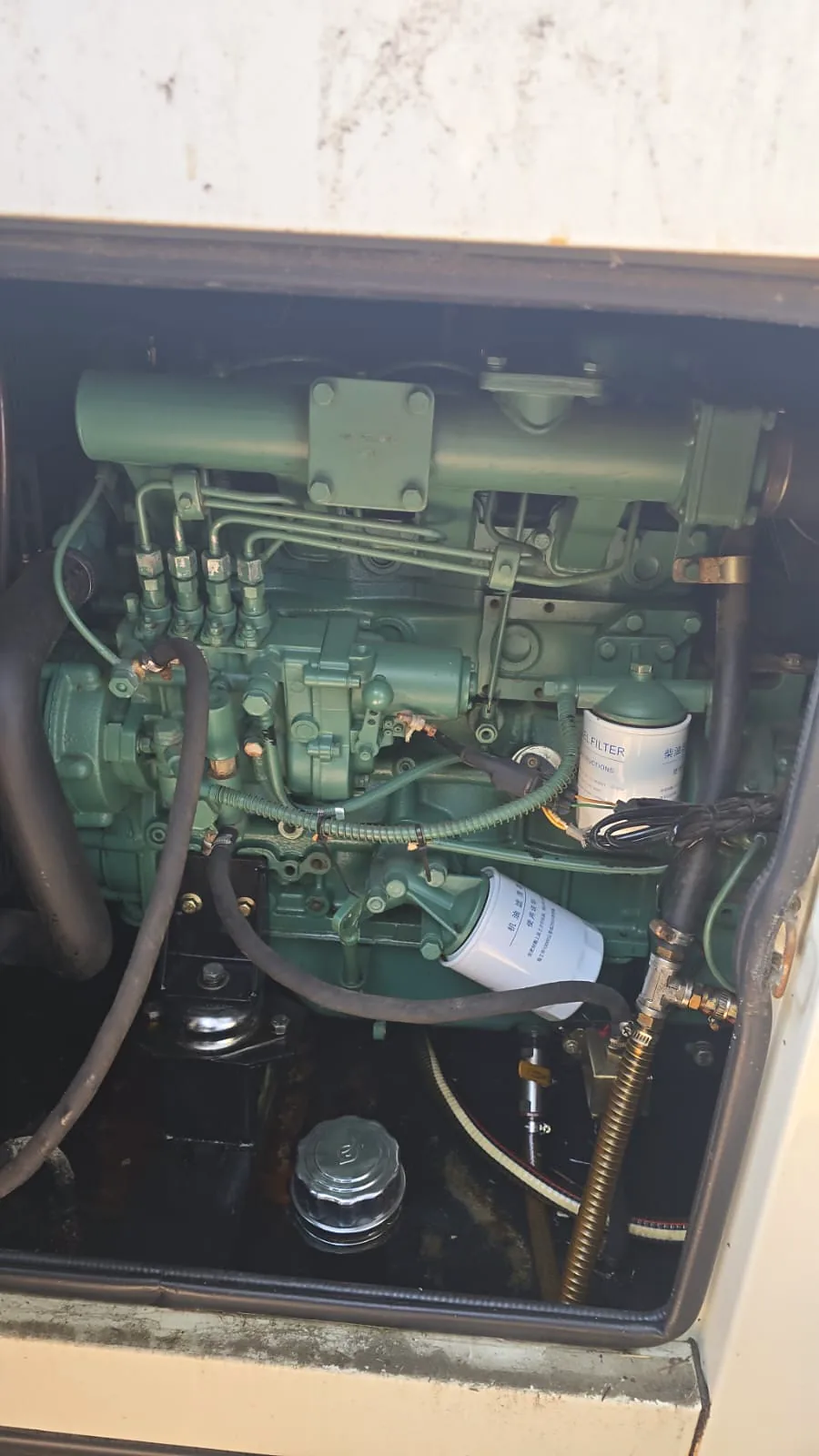
What a good service leaves you with
At the end of a service you should know what was done, which readings were taken, what was found and what needs attention before the next visit. Larger sites benefit from a record kept at every service, so trends such as rising oil use or a fuel filter blocking sooner each time show up early.
Anything that needs repair should be explained and quoted separately, so you can decide. Keep your weekly notes with that record. Preparing for a technician visit covers what helps on the day.
- Work done and parts fitted
- Hours, readings and test results
- Findings, with a separate quote for repairs
- When the next service falls due
FAQ
Frequently asked questions
Is an oil change the same as a service?
No. An oil change is one item on the list. A full service also covers fuel, cooling, air, the battery and charger, the alternator, the controller, the changeover and a test run, because a set with fresh oil can still fail to take the load.
Can I service my own generator?
You can do the weekly and monthly checks on this page, and on a small petrol unit many owners change the oil themselves. Filters on a diesel fuel system, electrical work, gas connections and the changeover need a technician, because a mistake there can stop the set starting or create a safety hazard.
How often should I do these owner checks?
Weekly and monthly as set out above, and more often during long spells of load shedding or after a storm. How often the full service is due depends on running hours and time; see service intervals and oil care.
Should I run my generator with nothing connected to exercise it?
A short start-up proves it runs, but long runs with no load let unburnt fuel build up in a diesel engine. An exercise run with some real load is better, and many controllers can run one on a timer.
Related pages
Need a generator technician?
- 24/7 operations
- We Arrive Within 1–2 Hours (usually within 1 hour)
- Free callouts and quotations