
Guides · Looking after a generator
Looking After Your Generator’s Coolant and Radiator
Looking after a liquid-cooled generator comes down to three things: the right coolant at the right strength, a level that stays between the marks, and a radiator that air can pass through freely. Check the level only when the engine is cold, use the coolant type the engine manufacturer specifies rather than going by colour, and have the strength, hoses, belts, pressure cap and thermostat checked at every service.
Technical guide · Last reviewed 16 October 2026
Coolant
What coolant does
Carries heat away
A large share of the fuel’s energy ends up as heat in the cylinder walls and head. Coolant carries it to the radiator for as long as the engine runs.
Stops corrosion and scale
Inhibitors protect the iron, aluminium, copper and brass in the system. They are used up over time, which is why coolant has a service life.
Resists freezing and boiling
Glycol lowers the freezing point for cold Highveld nights and, with the pressure cap, raises the boiling point for full load on a hot day.
Guards liners and the water pump
Heavy-duty diesel coolants protect cylinder liners from pitting caused by vibration (cavitation), and lubricate the water pump seal. Plain water does neither.
How the cooling circuit works
The water pump pushes coolant around the cylinders and head. While the engine warms up, the thermostat stays closed and returns coolant straight to the engine. Once warm, it opens, and hot coolant flows through the radiator, where the fan drives air through the fins, then back to the pump.
The system runs under pressure, held by the radiator or expansion tank cap, which lifts the boiling point well above 100 °C. That pressure is why coolant can burst out as scalding steam if a cap is opened on a hot engine.

Coolant types, and why not to mix them
| Type | How it protects | What to know |
|---|---|---|
| Conventional (inorganic) | How it protectsSilicates and phosphates coat the metal | What to knowOlder technology; the additives deplete sooner |
| Organic acid (OAT, long-life) | How it protectsOrganic acids act only where corrosion starts | What to knowLong life if kept unmixed; topping up with another type cuts it short |
| Hybrid (HOAT and similar) | How it protectsOrganic acids plus a little silicate or phosphate | What to knowFollow the exact specification the engine calls for |
| Heavy-duty diesel coolant | How it protectsAdds protection for wet cylinder liners | What to knowSome large diesels require it; a car coolant may not meet the specification |
Colour is not a guide: makers use one colour for different chemistries and different colours for the same one. Mixed types can lose protection or form sludge, so if you do not know what is in the engine, have it checked rather than guessing.
Getting the mixture right
A 50/50 mix of concentrate and water is the most common recommendation, but the engine manual decides. Too weak a mix gives poor corrosion and freeze protection. Too strong is not better: beyond the manual’s range the mixture carries heat less well and its freeze protection gets worse. Ready-mixed coolant avoids mixing errors.
Water should be clean and low in minerals, ideally distilled or deionised. Hard water, including some borehole water, leaves scale on the hottest surfaces, where it insulates the metal like scale in a kettle. Plain water alone gives no corrosion or freeze protection, so if some went in during an emergency, have the strength tested and corrected.
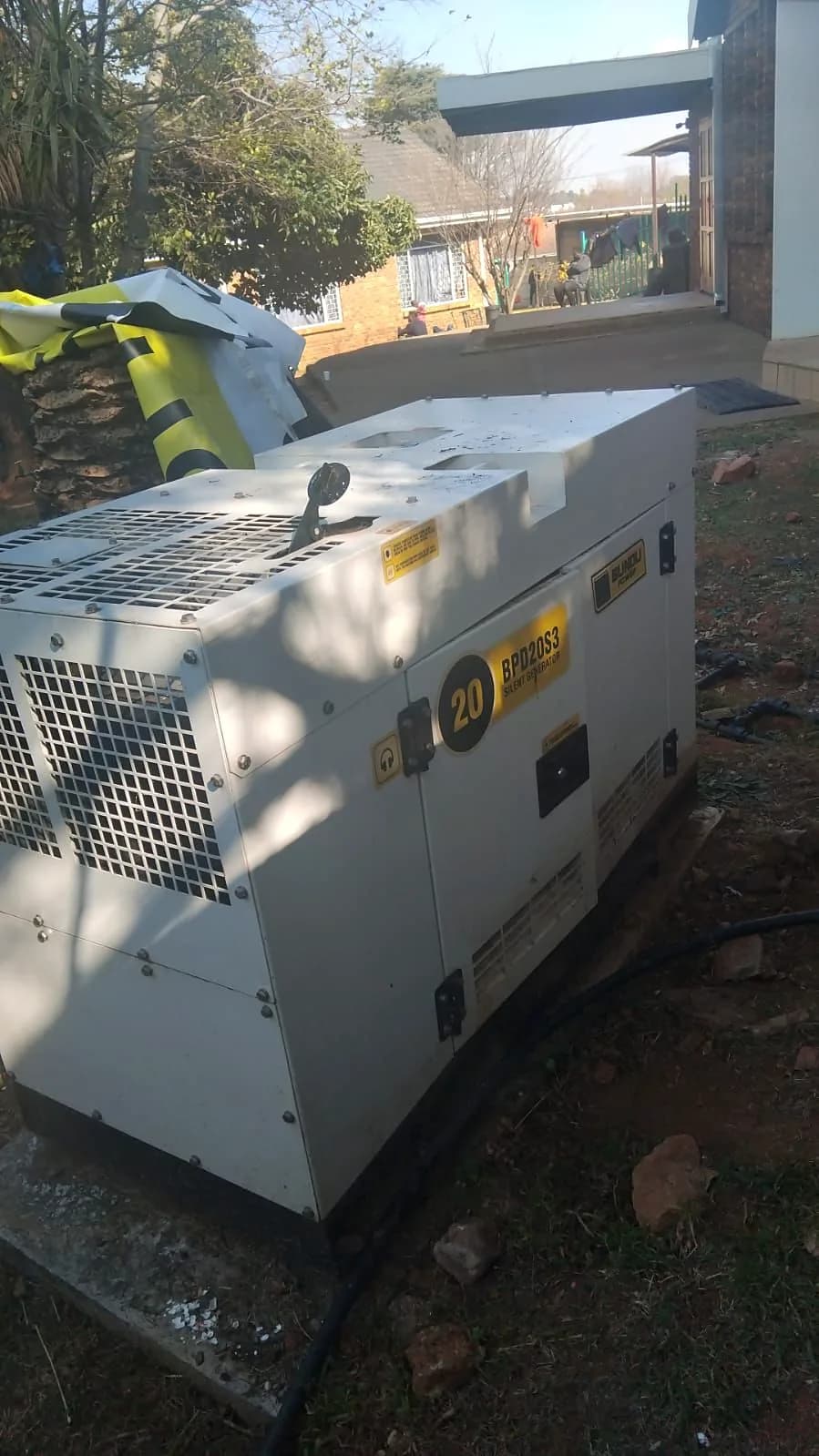
Where the set stands
Radiators in gardens, dusty yards and plant rooms
Where a generator stands decides how quickly its radiator clogs. In a garden, cut grass, leaves and blossom are drawn onto the core, and sprinklers wet it so dust sticks. On industrial sites and near building work, fine dust packs between the fins, and oil mist from a leak turns it into paste.
In plant rooms the core often stays cleaner, but the louvres, bird mesh and duct grilles that feed it collect dust, leaves and nests, and they are easy to forget because nobody looks at them.
- Keep plants trimmed back from the air inlet and outlet
- Clear louvres, bird mesh and duct grilles, not just the core
- Point sprinklers away from the generator
- Have oil leaks fixed, because they make dust cling
Owner checks, with the engine cold
Switch the controller to off first so a standby set cannot start. None of these needs tools.
- The coolant level in the expansion tank, against its cold or minimum mark
- Dried coolant crust or wet patches on hoses, joints and the radiator
- Drips under the set, and hoses that look cracked or swollen
- Dust, grass or leaves on the radiator face and canopy louvres
- Any coolant level or high temperature alarm on the controller
A level that keeps dropping with no visible leak may mean an internal leak or coolant boiling off. See overheating and leaks.
At a service
How a radiator is cleaned properly
- 01
Isolate the set
The controller is switched off and the battery disconnected, so the fan cannot turn.
- 02
Clean against the airflow
Low-pressure air or water pushes debris out the way it came. A high-pressure washer bends fins and drives dirt deeper.
- 03
Fix the cause
Oily dirt is degreased and the leak behind it repaired; bent fins are combed straight and the fan shroud checked.
- 04
Prove it under load
A core can be clean outside and scaled inside. Running on load while watching temperatures shows whether it needs flushing or specialist repair.
Hoses, belts, cap, thermostat and block heater
| Part | What is checked | Why it matters |
|---|---|---|
| Hoses and clamps | What is checkedCracks, swelling, softness and leaks | Why it mattersA hose that bursts on a long run empties the system in minutes |
| Fan belt | What is checkedCondition and tension | Why it mattersOn many engines it also drives the water pump and charging alternator |
| Pressure cap | What is checkedThat it seals and holds pressure | Why it mattersA weak cap lowers the boiling point |
| Thermostat | What is checkedThat it opens fully at the right temperature | Why it mattersStuck shut, the engine overheats; stuck open, it runs too cool |
| Water pump | What is checkedWeep-hole leaks and bearing noise | Why it mattersA failing pump circulates too little coolant |
| Block heater | What is checkedElement, thermostat, supply and coolant flow | Why it mattersKeeps a standby engine warm for easy winter starts; trapped air burns out the element |
Summer heat, load shedding and the next check
A long run at full load on a hot afternoon, during back-to-back outages, is the hardest work a radiator does. One that copes with a short weekly test can fall behind after a couple of hours. If your generator is already running hot, our overheating guide helps find out why.
Coolant strength, the radiator, hoses, belts, cap and thermostat are all part of a proper generator service, and a maintenance plan keeps those checks on schedule for sets that work hard. If you have found a leak, oil in the coolant or a radiator that will not stay clean, book a check and tell us the make, model and hour-meter reading.
FAQ
Frequently asked questions
How often should generator coolant be replaced?
At the interval in the engine manufacturer’s schedule, usually set by time as well as hours, because the inhibitors wear out even in a set that rarely runs. It is tested at each service and replaced sooner if weak or contaminated.
Can I clean the radiator with a pressure washer?
Not at high pressure: it bends the fins and pushes dirt deeper. A radiator is cleaned with low-pressure air or water against the airflow, with the set isolated and the alternator and electrics protected, which is why it is done at a service. Between services, with the set switched off, you can brush loose leaves and grass off the outside of the grille.
Why does my coolant level keep dropping?
An outside leak usually leaves stains or drips. With no sign of one, coolant may be escaping through a weak cap or leaking into the oil or exhaust; white, sweet-smelling smoke is one sign. See smoke.
Why is there oil in my coolant?
Usually a failed oil cooler or head gasket. Do not run the engine; have it inspected. See leaks.
Does my portable generator need coolant?
Most small petrol and many small diesel generators are air-cooled, with fins and a fan instead of a radiator. Keep the fins clean and never run one in an enclosed space. See portable and inverter generators.
Related pages
Related services
Related generator problems
Related brands
Need a generator technician?
- 24/7 operations
- We Arrive Within 1–2 Hours (usually within 1 hour)
- Free callouts and quotations